


 Back to ESSAYS
ESSAYS
Restructuring the World to Deconstruct Prejudice: The Power of Universal Design in Combating Disability Stigma

Illustration by Melody Zhang
The safety trope stamped on every elevator across the world reads “in case of fire, take the stairs,” but how does this urgent requirement apply to individuals with disabilities? This example reveals just how easy it can be to overlook the disability stigma that is tangibly ingrained in the surrounding world. Yet, how does policy approach the challenge of accessibility? According to Penn’s Office of Affirmative Action and Equal Opportunity Programs, “federal law defines a disability as any physical or mental impairment that substantially limits one or more major life activities.”1 Ideally, the goal of accessibility infrastructure is to lessen or eliminate these substantial limitations. However, this definition is inherently vague and raises the question: how is Penn’s campus, and the world at large, structured such that these impairments necessarily and “substantially” limit accessibility? Can we imagine a world where disabilities are not labeled thus and accommodations are universal?
College campuses pose a particularly interesting example of the structural presence of disability stigma across the United States. Amidst the emotionally and intellectually turbulent application process, able-bodied students fret over school statistics, location, and tuition, while students with disabilities must consider first and foremost whether or not a college has sufficient accommodations. Further, when advocating for accessibility requires exhaustive conversations concerning one’s disability, the very procurement of necessary accommodations can become tedious and serve as a constant reminder of this societal designation of “otherness.” In comedian and journalist Stella Young’s TEDtalk, “I’m not your inspiration, thank you very much,” she challenges the conventional “lie that disability is a Bad Thing, capital B, capital T.”2 In particular, Young subscribes to “the social model of disability, which tells us that we are more disabled by the society that we live in than by our bodies and our diagnoses,” and a poignant example of this lies in another common trope: “the only disability in life is a bad attitude.”3 Evidently, “no amount of smiling at a flight of stairs has ever made it turn into a ramp,” thus, rather than blaming an individual’s attitude for a lack of accessibility, Young identifies societal stigma as precisely where the notion of disabilities as “exceptional” emerges.4
To challenge these discriminatory societal tropes and envision a truly equitable campus where this “othering” is recognized as blatantly incorrect and replaced with genuine cultivation of empathy, we must reimagine our conception of what an accessible campus can and should look like. At bare minimum, we envision elevators, wheelchair ramps, and automatic doors. While certainly helpful, these physical modifications avoid a true restructuring of disability stigma. Is the goal to make spaces merely accessible via often roundabout means? Or can spaces strive to implement universal design, the demand that “everything—from products to the built environment—be usable to the greatest extent possible by everyone, regardless of their age, ability, or status in life.”5
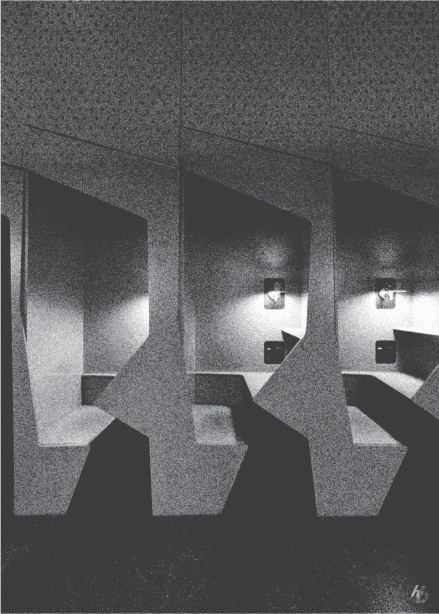
A prime example lies in the Rhode Island School of Design’s Fleet Library. Designed by Monica Ponce de Leon, currently the dean of the Princeton University School of Architecture, the Fleet Library actively envisions the ideal of universal design: “when we designed the cubicles for the library, no two cubicles are actually the same. We used software that allows you to design for variation as a way of creating a whole range of cubicles that had different sizes, differing height tables, different height seating, different widths, so that we could accommodate many different body types in a very subtle way.”6 With the vision of universal design, Ponce de Leon describes the ultimate goal “that we no longer think, again, of the wheelchair sign as the one that is imperative,” thus removing the very physical evidence of societal stigma.7
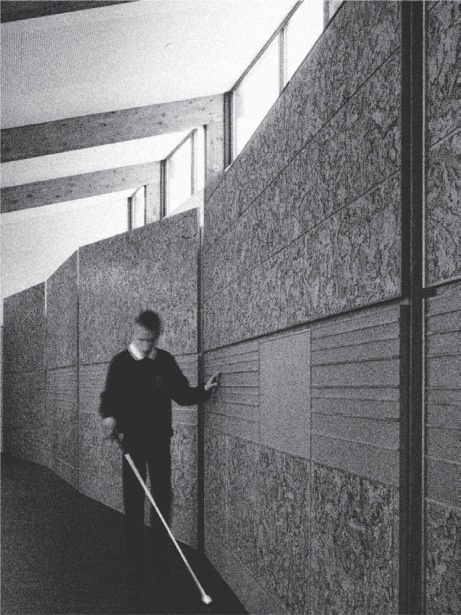
Glasgow’s Hazelwood School marks yet another manifestation of universal design. A cork-clad “sensory wall” maps the entire building with tactile cues, allowing visually impaired students to navigate the school independently. If you visit RISD’s library or the Hazelwood School, where people with disabilities can live as freely as possible, you might not view their disability as such. Importantly, neither of these designs feature elevators with the ironic demand to use the stairs in case of fire.8
I challenge you to imagine a world where disabilities shed their negative connotations, and physical spaces are naturally and equally accessible to all. By addressing the hybrid concept of universal design, and listening to insightful voices like Stella Young’s, we can imagine restructuring the world and our minds to overcome the detrimental presence of disability stigma.
Works Cited
- Penn Office of Affirmative Action & Equal Opportunity Programs. “Accommodation Services for Faculty, Staff & Visitors with Disabilities.” Penn OAA EOP.
- Young, Stella. “I’m Not Your Inspiration, Thank You Very Much.” TED, 2014.
- Ibid.
- Ibid.
- North Carolina State University, Center for Universal Design. “Principles of Universal Design,” 1997.
- Siegel, Robert, and Monica Ponce de Leon. “How the Disabilities Act Has Influenced Architecture.” NPR, 26 July 2010.
- Ibid.
- Bartolacci, James. “Architecture for All: 10 Thoughtfully Designed Buildings for People with Disabilities.” Architizer Journal, 10 May 2022.
- Dobraszczyk, Paul. “How Anarchist Architecture Could Help Us Build Back Better after Covid.” The Conversation, 19 Dec. 2022.
- Fleishman, Samantha. “The Accessibility of College Campuses for Students with Physical Disabilities.” Medium, 19 May 2017.
Author
Tova Tachau
Designer
Melody Zhang